Experimenting at enhancing soil conductivity with graphite.
I once chanced upon a very old photo. A commercial LF antenna was under final stages of construction. Shown were the concrete base and gigantic insulator. Topsoil had been stripped away for the laying of radials. A tractor was preparing the soil by spreading coke (purified carbon, a solid byproduct of coal gas production).
Metal, of course, trumps carbon hands down: radial wires at the base of a vertical, grid wires beneath a suspended horizontal.
You must, however...
When faced with such a roadblock, however, is there nothing at all you can do? Why not attempt enhancing conductivity in the actual soil itself.
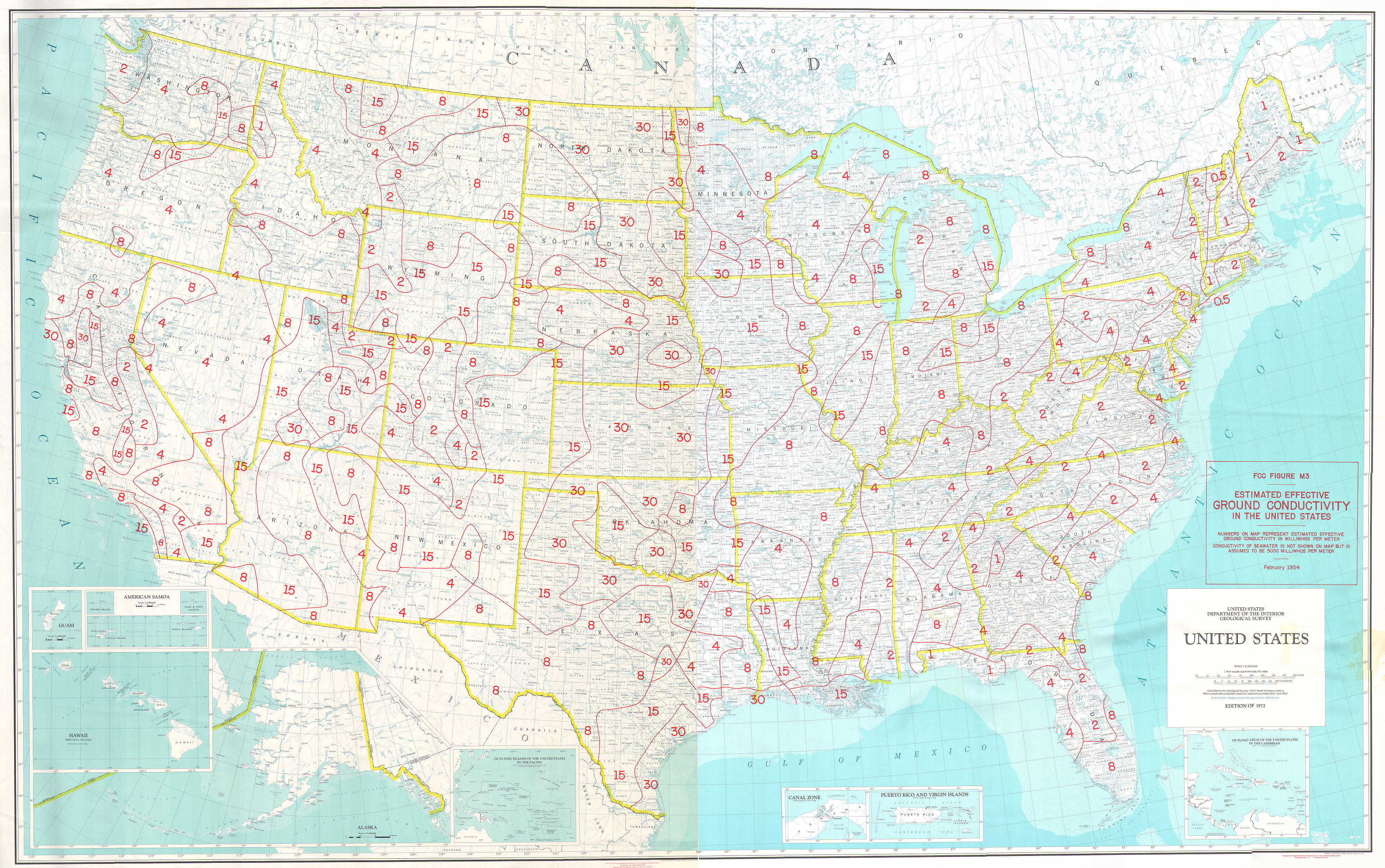
Below are thumbnails, each linking to a full-size map.
The FCC map, while interesting, is no use at all for ham radio purposes. Nor could I find any FCC map showing finer detail. I did, however, quite easily find state and county agricultural maps. And these, indeed, are exceedingly useful. This because farmers and ham radio operators alike both prefer the same types of soil: not too much clay; not too much sand; neither to wet nor to dry.
No coincidence at all that we call them antenna farms.
As I live in a very particular area of Port Sheldon Township, the state and county maps above describe my soil as rubicon, which is to say, almost pure sand. No surprise, since we live just one mile inland from the Lake Michigan shoreline.
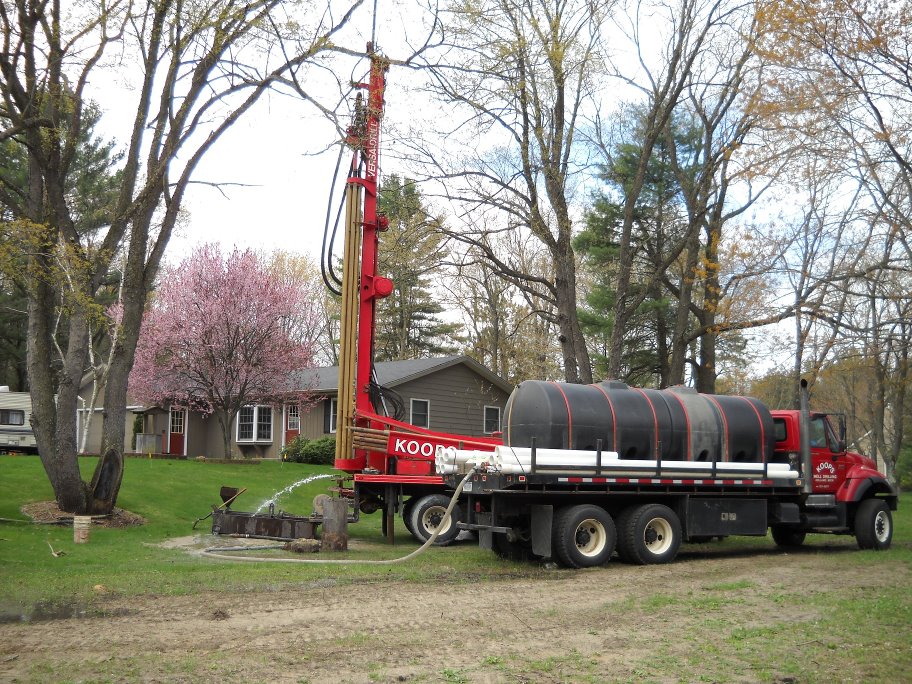
A post-hole digger, anywhere at all in my yard, will in the very first scoop, bring up sand beneath a few scant inches of topsoil. From there on it’s sand all the way down until hitting clay at 42 feet. Which fact I happen to know from paying for a new well to be drilled at time of purchase.
|
|
Carbon is used as electrodes in high-power arch lamps and aluminum smelting furnaces, as scrificial anodes for bridges, pipelines and building foundations. Activated carbon is used in water purification systems, and as dietary supplements to aid digestion. In its graphite form, carbon is used as seed lubricant for planting food crops.
In order of increasing conductivity, carbon comes in three forms:
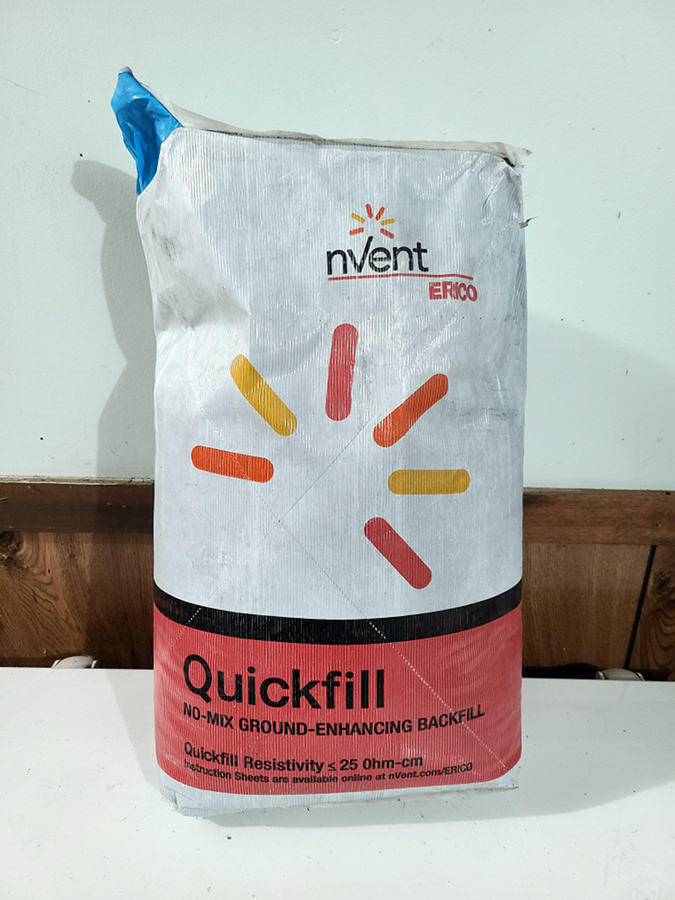
This would be the most convenient, commercial option. Just a bit pricey, however. On that account, I did not use it, going with sand-like, waste-graphite instead. Still, I think it well worth describing, as I do use it, but for pre-filling post holes into which I drive ground rods.
Do not repeat this. It is not at all the best way. But that is how learning curves work. So...
My first idea was to employ Easy-Slide seed-lubricant graphite from Blair’s Farm & Fleet. Not the worst idea I’ve had to date, but it comes close.
|
|
|
|
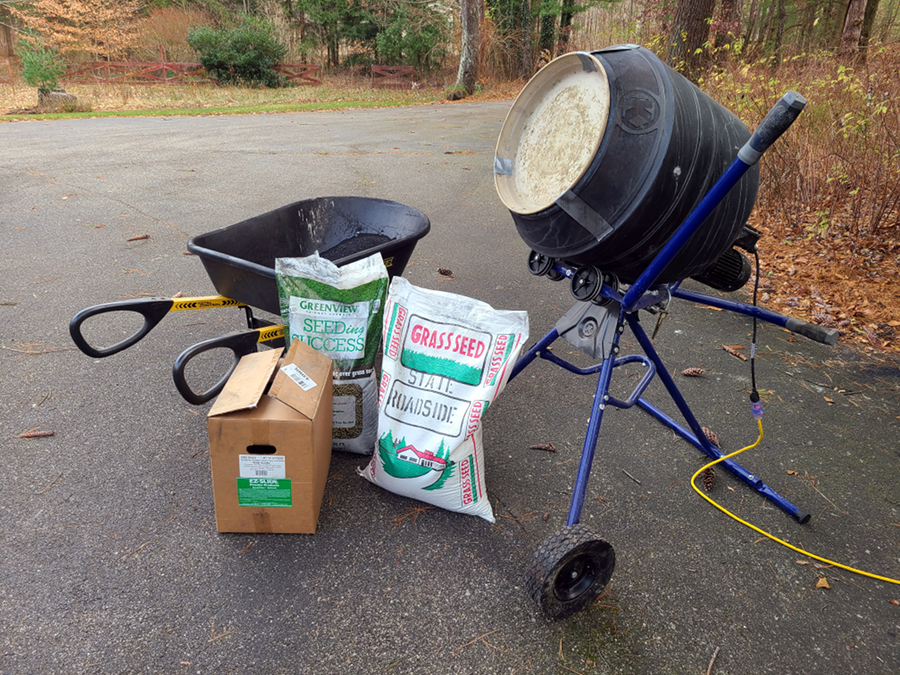
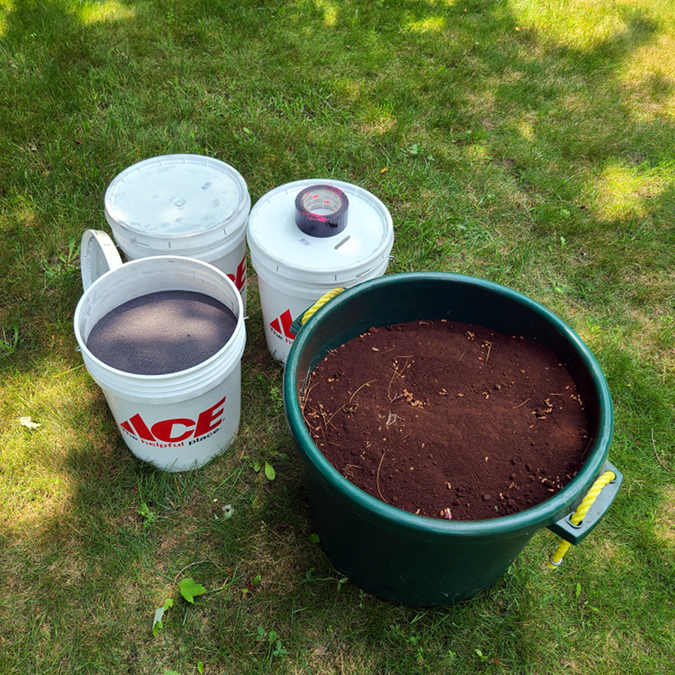
Both this first time and the much-improved effort to follow, I mixed my chosen ingredients using a cement mixer. I capped the mixer’s open mouth with a plastic flower pot tray, needful to stop the fine-power graphite from billowing away downwind in a huge cloud.
The graphite being very fine dust, I mixed it together with other lawn products: grass seed, and Seed-Success Pellets. The latter is a paper product whose purpose is to halt errosion and retain moisture. Normally each pellet will bloom the moment it gets wet. As turned out, however, the mearest coating of fine graphite dust so repelled water as to delay said blooming for a very long time.
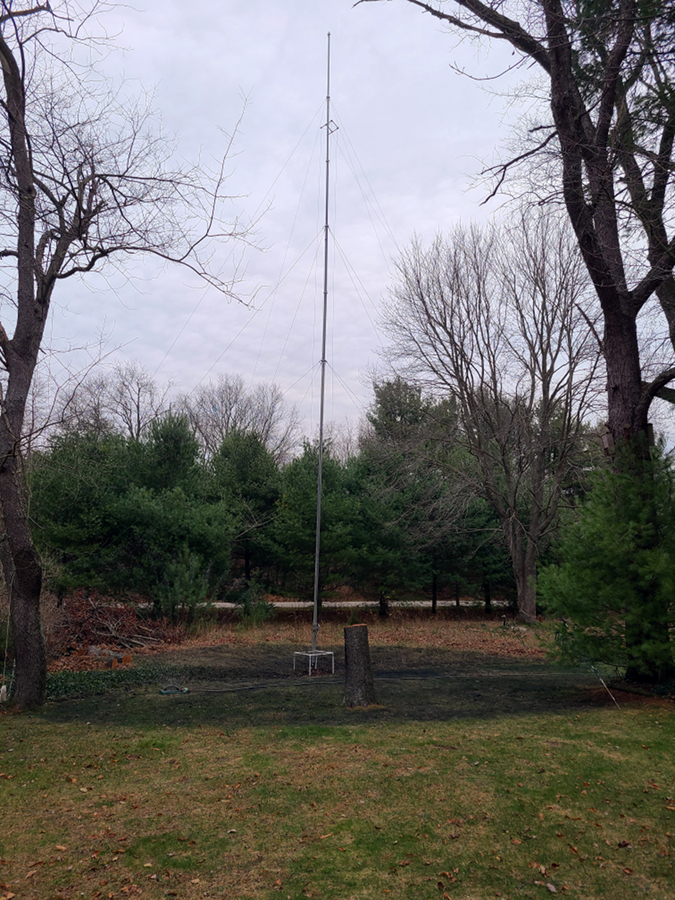
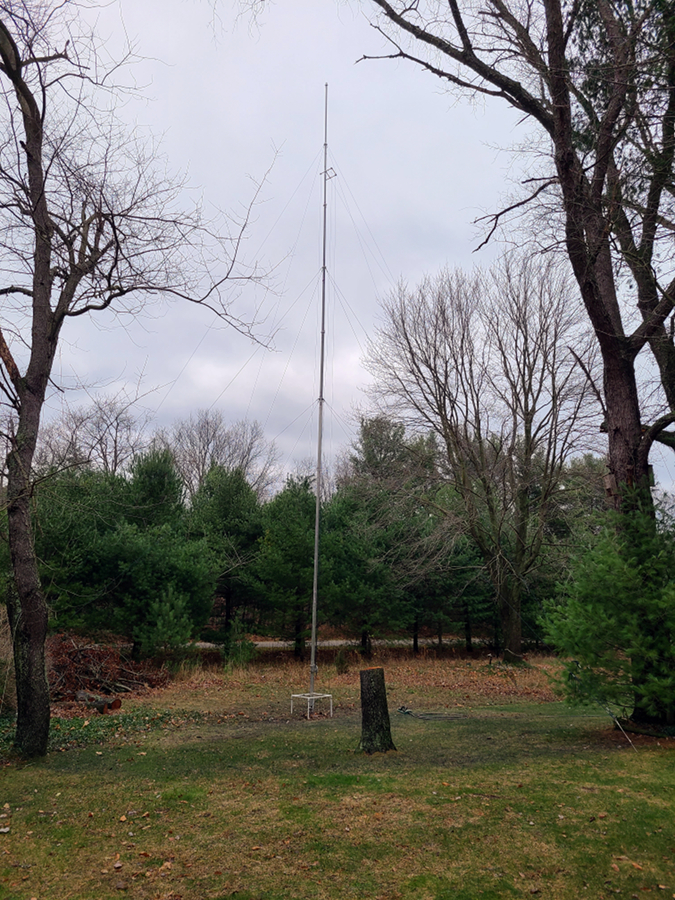
Distribution onto the ground around the base of my vertical mast was performed with a seed/fertilizer spreader. As with the concrete mixer, this had me walking behind and into a constantly billowing cloud of black dust. As PPE, I wore a painter’s paper coverall, dust mask, and goggles. Even so, they weren’t enough. Live and learn.
This way does work. Very likely, I will repeat it again at some point.
|
|
Having learned from the above, multi-part mistake, I found a much cheaper, and very much better source. Specialty fabricators exist which machine parts from blocks of pure graphite. As with any subractive process, they generate a lot of waste. This they sell back to the graphite vendor who reprocess it back into blocks.
The first such fabricator I called was happey to sell me any amount of their waste product at a small markup from what the graphite vendor paid them.
|
|
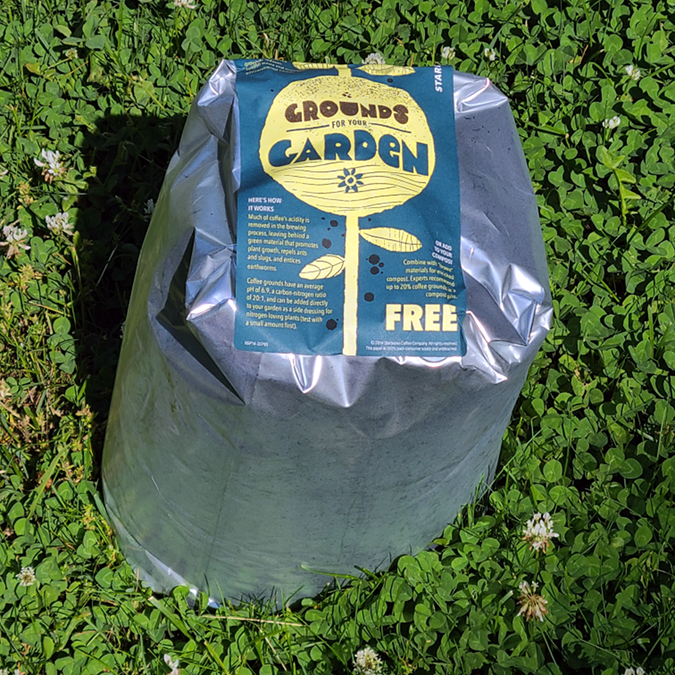
Yes, you saw and read right. One morning, while cleaning out the coffee pot, I noticed as how spent coffee grounds had all the requisite qualities which Seed-Success pellets has so sorely lacked. That while also being entirely non-toxic (mostly). But how could I possibly obtain enough to equal a 25-lbs sack?
Well, at work there are a number of break rooms, all of which go through quite a bit of coffee. The cleaning crew was happy enough for me to instead clean out the urns. That was a start. One day while so doing, a fellow employee told me that she got coffee grounds for composting into her garden free from Starbucks.
And, as further turns out, many a non-Starbucks coffee shop does likewise. Any they don’t succeed in giving away for free they must instead pay to dispose of. I have since managed to collect quite a lot. Enough for round two, and plenty more.
Spent coffee grounds are tailor made for dust control. Not that there is all that much dust in the very sand-like waste graphite from my new source. The grounds have high affinity for adhereing dust while still not becoming hygrophobic as a result. In short, it is the perfect solution.
In order to know to what degree my application of graphite worked in each of the two experiments, I needed to measure it somehow. Three possible ways came to mind.
The last method works well plenty enough. Repeatable results were obtained.
Next came the quesiton of how to conduct the measurements I needed to take. After some thought I concluded that no attempt to measure the same plot before and after could possily serve. The reasons were plural.
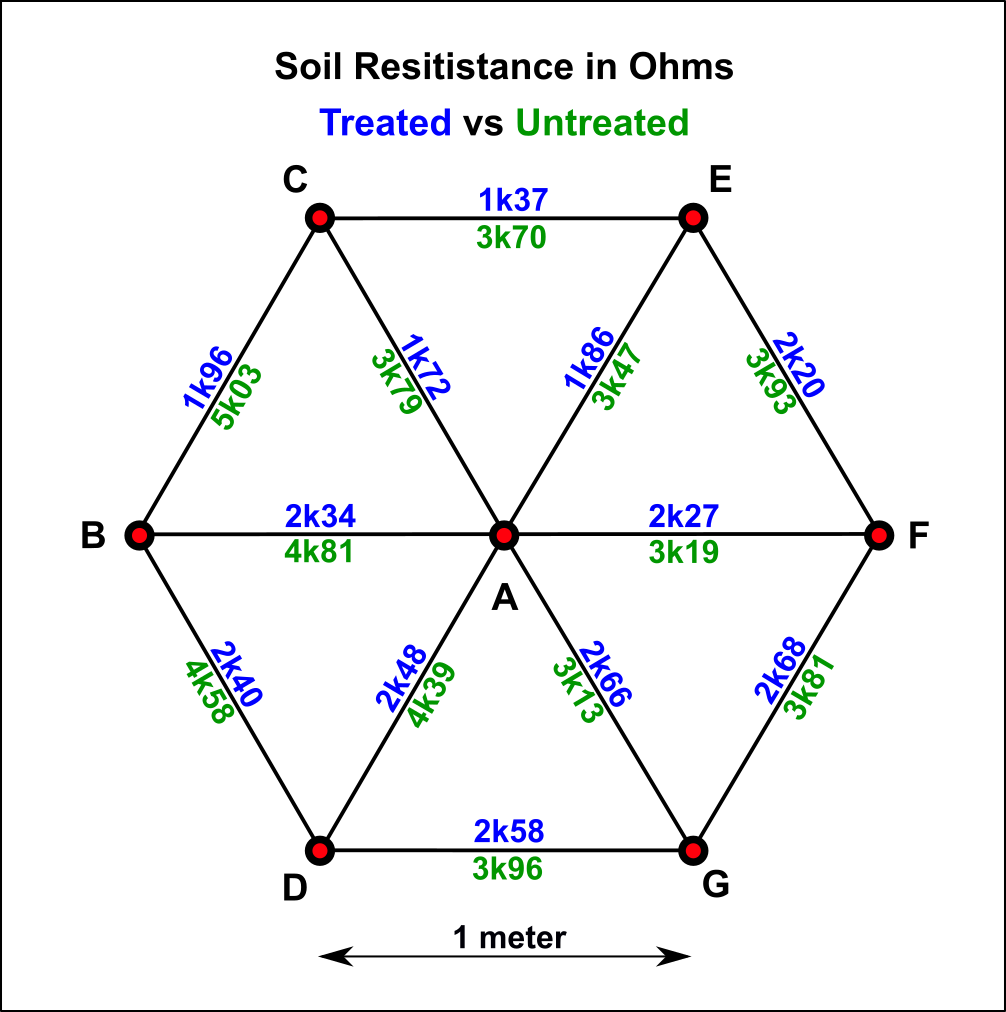
I settled, therefor, on compareing instead treated versus untreated plots. I would take both sets of readings a full 30-plus days post-treatment. Transient, ultra-short-term benefits ought by then to have faded away. Plots would be within and just slightly outside of the treated 24-foot radius near the mast’s base, both at the same dranage level.
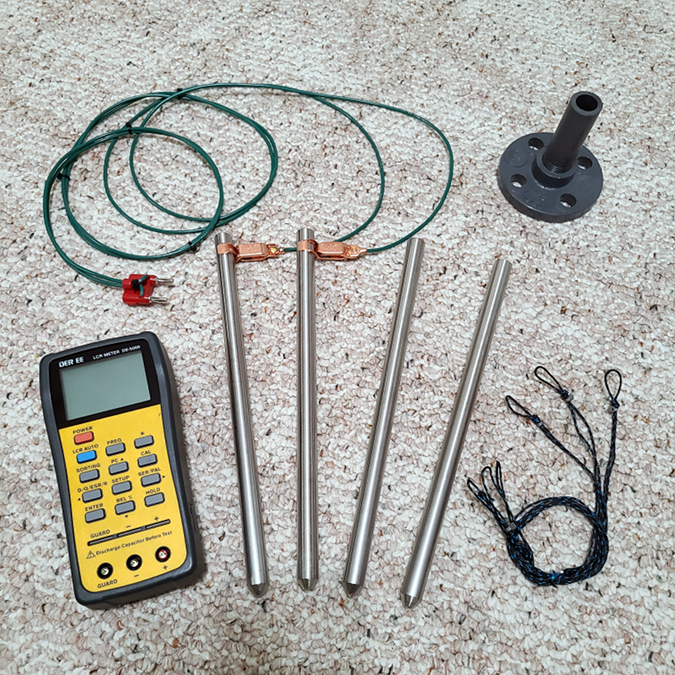
I cobbled together the following items:
|
|
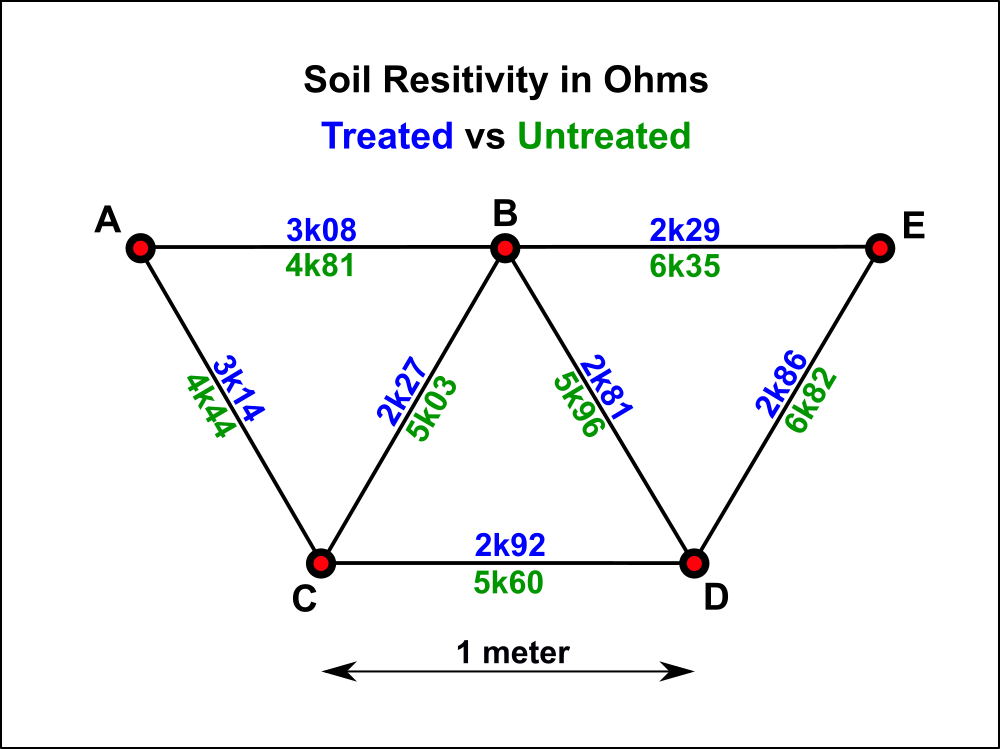
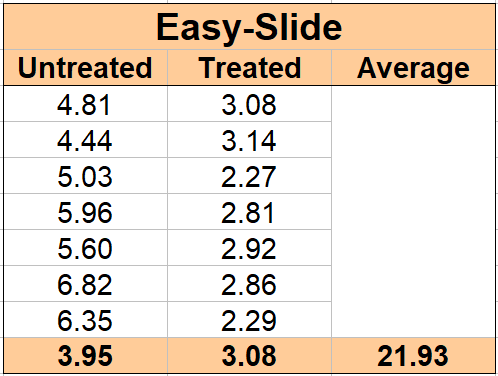
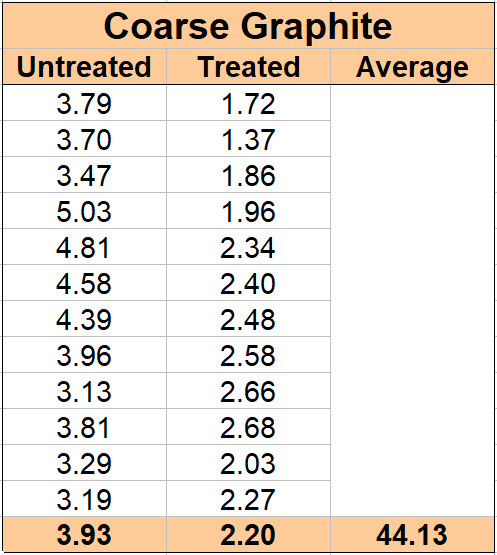
At left below, are measurements 30 days after Experiment 1. At right the same for Experiment 2. The matrices are unequal because of poor planning. I had intended that both should be like the larger, mistakenly thinking that three probes alone would suffice. In this I had erred, and made a fourth probe prior to collecting the second matrix.
|
|
|
The trouble with having just only three probes was for not wanting to re-use a probe hole. Try it on a table top with coins instead to see what I mean. Instead of just three, four are required in order to not lift-and-replace any given location twice.
That question answered, I put the figures into a spreadsheet to solve for the averages, and thereby compare the two.
|
|
|
It may be argued that since Experiment 2 was, of a necessity, performed on the same two plots of soil, there may hav been residual benefit left over from Experiment 1. Nor can I argue definitively that this is not the case. I can only point out that in the several months which passed in between, all remaining visible traces of the ultra-fine graphite powder employed for Experiment 1 had since disappeared. This as opposed to granules of darkest black being indeed detectable after passage of an even longer period after completion of Experiment 2.
A curious caveat must here be mentioned. Improvements in soil conductivity can produce this effect. Prior to actually conducting Experiment 1, I described my intended procedure to a group of friends during a CW round-table net. Duke Wall, WA9WJB in Batavia IL, took the concept to heart, trying it out for himself.
Some few days later on that same roundtable net, Duke reported having applied a single pound of Easy-Slide graphite, soaking it into the clay around the ground stake of his 160m vertical. As an immediate effect, the resonance of his vertical was lowered by 2kHz. The resonance shift did not go away, but proved permanent. In the end, he had to re-tune it.
My own folded monopole, being of non-resonant length, exhibited a similar change of behavior. I was accustomed to tuning it from inside the shack by means of an MFJ-984 T-match. After each graphite treatment, my prior written list of band settings no longer worked. New lists of settings for CXMTR and CANT had to be found and written down for all bands on each occasion.
Results of my two experiments are mostly informational. I list them as follows:
Why not a belt-and-suspenders approach? Augment the effectiveness of grid or radial wires by adding carbon to the soil in which they are buried. Just like how I saw pictured in that old photo. A little bit of something extra that is both good for the soil and also may help pull in rare DX? Sure, why not?
In lieu of expensive graphite, other substances might come to mind. Know, however that to avoid contaminating ground water, the following three should be stricken from any such list:
Latin for “Let the moocher beware”. I composed this for me, and employed it with glee. I share it here with you for free, but offered without even so much as the smell of a dead warranty (or wheriot, as the case may be). Whatsoever disasters of cosmic proportion as may result from the use of this information, any and all culpability rests wholly and solely with the user.
My contact email and postal address are on QRZ.com for call sign KY8D